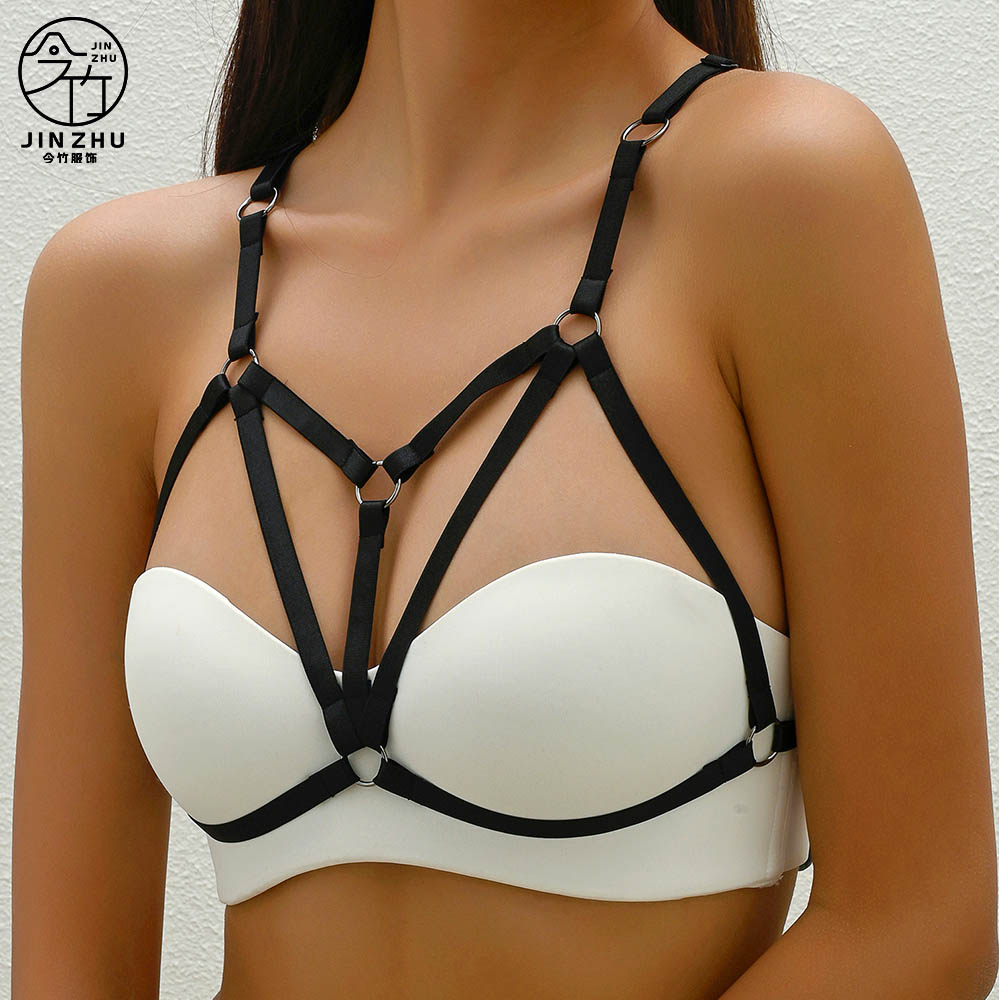
For a geometric chest harness enquiry, a useful sample record maps the visible strap routes and ring positions against one identified product reference. Jinzhu’s Geometric Chest Harness page shows a black strap accessory over a white garment. The front photograph can support a clear appearance discussion, while unseen construction, dimensions and technical performance remain separate questions. Label the reference areas, request any missing views and record the supplier’s response against the actual offered sample rather than approving an unspecified catalogue category.
Separate the accessory reference from the styled outfit
Start with the Geometric Chest Harness product page and save the official reference with its date. Retain the JINZHU mark on the original photograph. Give the accessory a buyer reference code and ask the supplier for the exact offered product identifier. The white garment underneath helps show the strap outline, but its presence in the scene does not establish that it is included in the quoted item.
Use neutral component descriptions in the enquiry: visible black straps, visible connecting rings and visible adjustment areas. The product page names several materials, but the photograph alone cannot allocate those materials to particular parts. Keep the appearance record focused on the selected layout. A separate supplier material statement can identify which component each listed material describes without changing the visual reference.
• Keep the untouched official photograph and a separately labelled working reference.
• Identify the accessory itself; ask about any additional garments as separate supply lines.
• Use one actual sample identifier for every view of the offered version.
Label the strap routes and ring junctions consistently
Assign simple location codes to the visible upper strap sections, central junctions and lower connecting sections. The codes are correspondence aids, not claims about the supplier’s manufacturing system. Point each comment to a particular location and view. A request such as clarify the central ring connection is easier to answer when the relevant junction is labelled rather than left to interpretation.
Record what can actually be seen at each junction. The front image can show where visible straps meet a ring, but it does not reveal every reverse attachment or concealed end. Request another identified view where the detail matters to the buyer. Do not fill an unseen connection into a technical drawing based only on the apparent symmetry of the front arrangement.
Reference area
Appearance record
Supplier clarification if needed
Upper strap sections
Visible route and relation to the selected front view
Identify any covered or reverse sections
Central ring junctions
Location and visible strap connections
Provide a view of any concealed connection
Lower connecting sections
Visible route and alignment comments
Confirm the exact offered layout
Adjustment areas
Where adjustment hardware appears in the reference
Identify the actual component without assuming a range
Reverse view
Not observed in the single catalogue photograph
Request an identified view of the offered sample
Ask for comparable sample views before closing a query
When an actual sample is available, ask for the views needed to answer the labelled questions. Record the sample identifier, orientation and reference revision with each view. The supplier’s response should make clear which actual version is being shown. A differently arranged photograph may answer a question, but it should not silently replace the reference being discussed.
Keep changes in presentation separate from changes in the item. Lighting, background and the underlying garment can affect how the black straps and reflective rings appear. Use a matched presentation where practical for appearance comparison. A screen image remains a visual reference rather than a measured colour standard or evidence of the hardware’s composition, coating or surface performance.
Use narrow approval states for the actual decision
Give each labelled area a response state such as accepted for appearance, clarification requested or not observed. Include the reviewer and date. A comment accepting the visible position of a ring should retain that scope when forwarded to purchasing. It does not establish a dimension, load rating, attachment test result or a recommendation about how the item should be worn.
The page describes an adjustable accessory, but the appearance record does not establish the adjustment range or its suitability for a particular wearer. Request any needed dimensional information through a separate product-specific specification question. This procurement document is for identification and visual agreement; it does not provide fit, restraint, load-bearing or safety-use instructions.
Version the accepted reference without erasing open details
If the supplier proposes a changed strap route, ring placement or hardware appearance, save a new reference version. Record which areas changed and which earlier comments still apply. Preserve the earlier photograph and response. This creates a traceable decision record instead of leaving the buyer to guess whether a later sample matches the original enquiry or a revised offer.
Send unresolved appearance questions through Jinzhu’s contact page with the labelled image attached. The Jinzhu blog can link to related purchasing notes, while the actual sample file retains the supplier’s response and any accepted view. The useful result is a clearly identified accessory layout with known appearance decisions and visible evidence gaps, ready to support a commercial discussion without assuming the contents of the styled outfit.
Frequently asked questions
Is the white garment in the catalogue image included?
The image does not establish supplied contents. Ask the supplier to identify the quoted accessory and confirm any separately requested garment lines.
Can the reverse connections be copied from the front layout?
No. Mark them not observed and request a view of the offered sample if that detail is needed for the purchasing decision.
Does visible adjustment hardware establish an adjustment range?
No. Its location can be recorded for identification, while the actual range and method require separate supplier information.
Does an appearance approval establish technical performance?
No. Keep the accepted visual areas and their reference version explicit. Dimensions, materials, attachment performance and applicable requirements need their own evidence.
Product and contact references
https://jzlingerie.com/product/geometric-chest-harness-adjustable-elastic-straps/
https://jzlingerie.com/contact/
https://jzlingerie.com/blog/